No More Processing Fees
Account-to-account transfers removed card processing fees entirely.
Merchants kept more revenue from every transaction without changing how they work.
Funds in Seconds, Not Days
Customers left dealerships with funds already in their accounts.
What previously took days now completed while they were
still on-site.
85% Adoption Rate
What started as a pilot became the default way dealerships send money.
85% of transactions are now utilizing the Pay By Bank feature.
Refined Design System
Through design system refinement, we accelerated ideation and development by 40%
What used to take weeks now takes days.
Opportunity
Combat Rising Fraud
1 in 5 UK dealerships were hit by payment fraud in 2024, with chargeback losses running into thousands per incident. Card payments had no reliable authentication layer. Open banking flipped that. Customers verify through their own bank, which means the identity check happens at the source, not a third-party form.
Regulations Were Here
Challenges
20+ Statuses, Zero Context
The API returned over 20 transaction statuses written for engineers, not dealership staff. Terms like payment_settled and PIN_LOCKED needed human translations and clear next actions. I mapped every status to a user-facing label before touching a single screen.
The Trust Handoff
Completing a payout required users to leave Prommt, authenticate through PayIt, then return. At the most critical moment in the flow, users were on someone else's product. Visual continuity and messaging had to work hard enough that the transition felt invisible.
Discovery
Before designing anything, I needed to understand what NatWest's API could actually do and where its limits would constrain the experience. The merchant workflow problem was already visible. The harder question was whether the technical infrastructure could support a flow that felt simple enough for dealership staff to use without training.
I worked through the API documentation and UK open banking regulatory requirements to map what was possible, what was mandatory, and what would create friction if handled wrong. Three things became clear early: the authentication flow had non-negotiable steps that couldn't be shortened, the status response system was built for engineers not end users, and the handoff to PayIt was unavoidable.
That last point shaped everything. The solution wasn't going to be seamless in the traditional sense. It was going to ask users to leave the product at the most sensitive moment. The design challenge wasn't simplifying the flow. It was building enough trust that users would follow it anyway.
Research
Before opening Figma, I needed to define the translation layer:
What every status meant in plain language
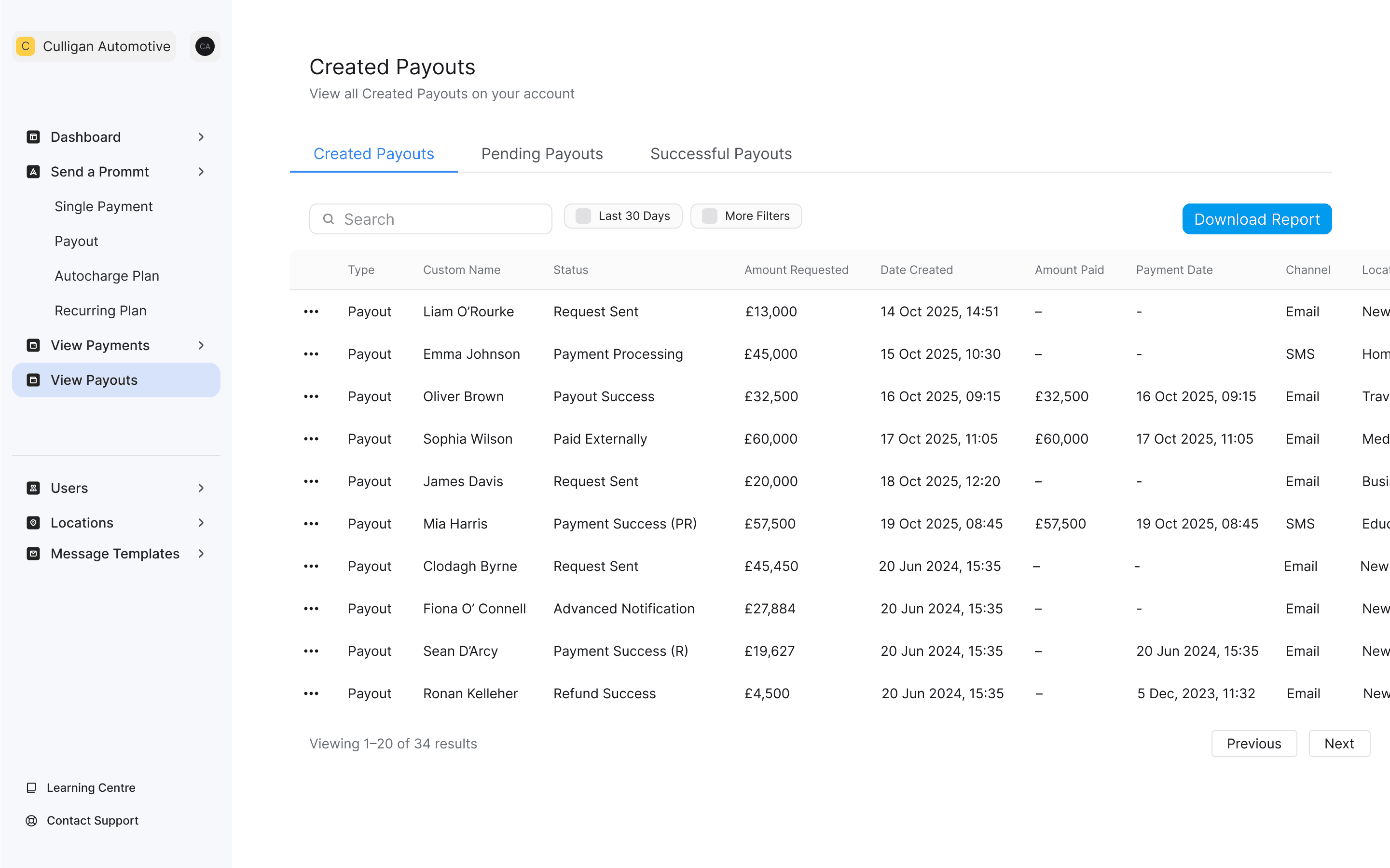
Translated 20+ complex API codes into human-readable labels; for example, mapping payment_settled to "Payout Success" so merchants could track transactions at a glance.
Data Abstraction
Replaced backend technical fields (e.g., merchant_id, brand_id) with intuitive business inputs like a "Location" dropdown, ensuring that non-technical would understand.
Edge Case Handling
Identified customer-facing technicalities like PIN_LOCKED that required no merchant UI but were mapped to a Transaction Detail View to empower staff with a transaction timeline & troubleshooting logic.
Workflows
Merchant Side: Creating Payout
Everything in the Research section had one job: make this invisible. The merchant flow had to feel like sending a message. The customer flow had to feel like receiving one.
Underneath both was an OAuth handoff, real-time status polling, and a three-party authentication system. None of that needed to be the user's problem.

Dealership staff access the payout form and input:
Amount
Secret answer
Customer details
Delivery channel (email/SMS/link).
They can customize the message or use the default provided.
Review and send.
Customer Side: Receiving the Payout

Customers receive branded notifications via
SMS, Email, or link) with transaction details, security answer and a link to complete the payout.
Customers enter their security answer
Select their bank from 300+ options via PayIt
Authenticate through their bank's portal
Choose Account & receive funds instantly.
Transparency = Trust
Notifications explain exactly what customers need to do and why. Each screen reinforces security through clear messaging & branding about the merchant, transaction amount, and verification purpose.
Customers always know what's happening and what comes next, reducing anxiety around a new payment method.
Authentication & Security
Customers authenticate through their own bank's portal, not a third-party login screen. PayIt connects to 300+ UK banks, allowing customers to use existing credentials in a familiar interface.
No sensitive banking details are shared with merchants, maintaining security and privacy.
Instant Gratification
After verification and bank selection, funds arrive in customer accounts instantly. Customers leave dealerships with money already transferred:
- No check deposits
- No 3-5 day waiting periods
- No trips to the bank
Design System Improvements
The Problem
Prommt's design system worked until you tried to use it somewhere new. Data tables had to be manually rebuilt for every context. Tab selectors duplicated every time a new view was needed. Components were detached, renamed, and left to drift. Nomenclature was inconsistent enough that finding anything required asking someone.
I audited every component, fixed the architecture, and shipped it alongside the payout feature.
The Solution
Robust Components
Button groups, tab selectors, and data tables built with variants and booleans. Swap states, adjust layouts, change content without detaching from the master component.
Rapid Ideation
The payout table fully designed across every state, empty, loading, confirmed transaction, error, and sidepanel without rebuilding or detaching a single component.
Organized Design System
Applied consistent naming and syntax across every component so designers can find what they need via Figma's search, from any file, without opening the design system directly.
The Impact
Feature iteration and delivery accelerated by 40%.
This efficiency gain compounds across every subsequent design excercise, feature & established reusable patterns for future products at Prommt.
Key Takeaways
→ Technical constraints are a design problem
NatWest's three-part data structure and 20+ API statuses weren't engineering concerns to hand off — they were the design brief. Translating them into a merchant experience that felt simple was the core challenge.
→ Security becomes trust when you frame it right
The secret answer requirement could have felt like friction. Positioned correctly, it became the feature that made merchants confident enough to adopt.
→ Information Architecture
Organizing 20+ statuses by "what users need to do" rather than backend processes made the system understandable to non-technical dealership staff.
→ Design Systems are product infrastructure
Fixing component architecture mid-project is expensive.
The 40% efficiency gain wasn't a bonus it was the cost of not having it right from the start.